
A Fragile Culture Series
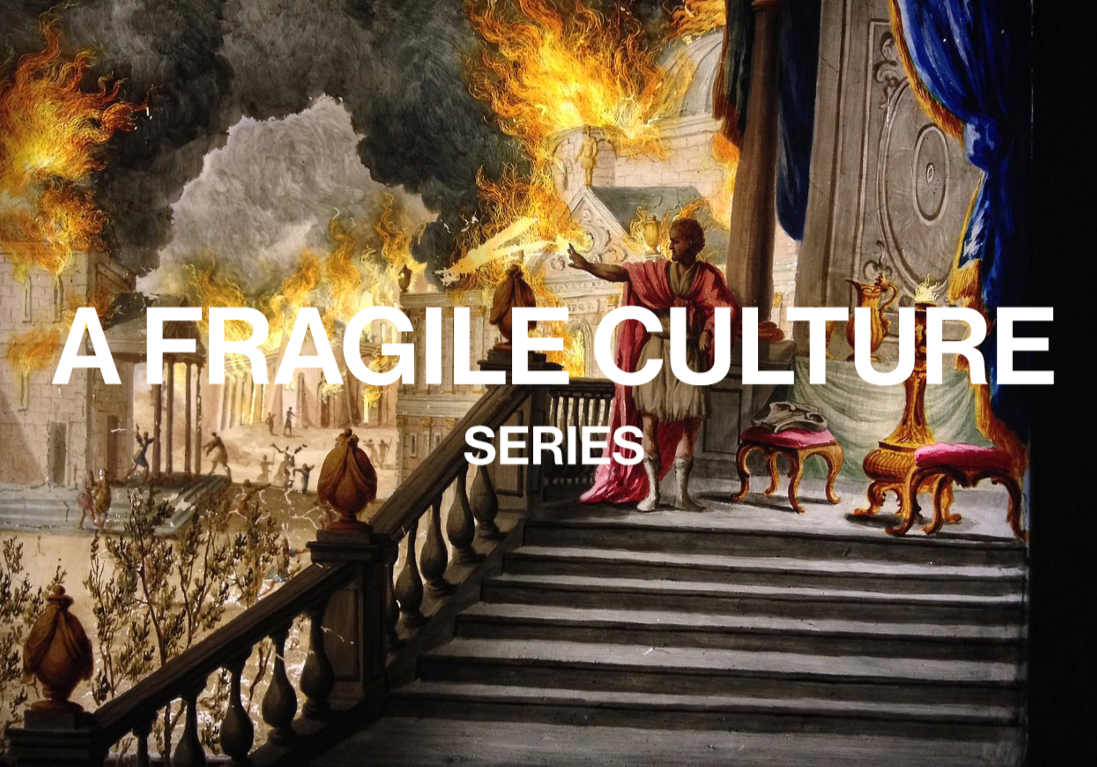
The Emperor Nero Contemplating the Fire of Rome on July 18, 64, Artist Unknown
A Fragile Culture Explanation & The Ancient Rome Design
An Introduction to Fragile Culture and its First Case Study
A Fragile Culture started from a simple observation and that is modern culture looks strong, but it breaks easily.
Everything today moves very fast, think Trends, Aesthetics, Opinions, and Identities.
They rise, peak, and then disappear at a pace that is considered normal now. What feels so dominant one year is irrelevant the next. Meaning never gets time to settle. It collapses faster than it’s built.
As I’ve said before, “Fragile Culture is along term conceptual series about how modern culture appears strong but breaks easily.”
This isn’t anti culture. It’s observational.
“It studies how symbols, systems, and identities lose permanence when they’re treated as disposable.”
When everything is replaceable, nothing gets to last long enough to even matter.
Every culture believes it will last.
I wan’t you to think back to ancient Rome under the reign of Emperor Nero and Rome before it.
At its height, it was unavoidable and organized. From the inside, it most likely felt permanent.
From the outside, it defined the world. And yet, it collapsed.
One of the most common images tied to that moment is Emperor Nero, not because he caused the fall alone, but because he represents something more familiar than people like to admit.
Nero wasn’t followed because he was the most capable or thoughtful leader in any way.
He was followed because he was this visible figure. Shaping taste, spectacle, and attention while the structure underneath Rome weakened. That’s the parallel.
Emperor Nero isn’t important as a person, more as a signal.
He represents what happens when visibility becomes authority and spectacle replaces understanding.
Rome didn't fall because of one leader, it slowly weakened because direction started coming from figures who were followed more for attention than for judgement.
This is the dynamic that A Fragile Culture is interested in.
Not Rome itself, and not a single historical moment although many will be explored later on, but the conditions that allow cultures to feel permanent while becoming increasingly unstable.
The reason this series exists is because those same conditions are now visible today unfortunately.
Culture now is shaped less by careful though and more by speed.
Ideas tend to be elevated quickly, repeated until they feel unavoidable, and then discarded without reflection.
The people setting direction are often the most visible people, not the most considered.
And because everything moves so quick, there’s little to no time to question whether the thing your following is actually worth sustaining.
A Fragile Culture explores what happens when permance stops being a goal.
When systems are designed to refresh instead of endure.
When identity, meaning, and aesthetics are treated as an interchangeable rather than built slowly over time.
This is why this series won’t be tied to that single image or reference, for research and design purposes too.
Rome is not the identity of a Fragile Culture, rather it’s evidence.
Other designs in the series look elsewhere, but they follow the same logic as the one before it: Observing moments where culture appears confident, dominant, and complete, all while quietly showing these signs of fracture underneath.
This work isn’t trying to predict collapse or dramatize it in any sort of way. It instead is trying to understand the behavior that leads up to it. The habits, the incentives, and the patterns that make instability feel normal.
That’s what the series is exploring, not the end of culture, but the point where it becomes easy to break and reaction that follows.
